
This piece is a continuation of The Place Issue from earlier this year. We spent most of our summer at the Hollywood Public Pool, and we learned in early September, from a group of upset regulars, that they would be closing for six weeks in the fall.
We lean on interviews and personal account to tell the story of a policy or a place or a cultural question, and, this week, we tried to synthesize and capture what a summer at the pool felt like, and what it feels like for the people who depend on public spaces when those spaces close — even if only temporarily.
Subscribe to stay up to date and to keep franknews independent.
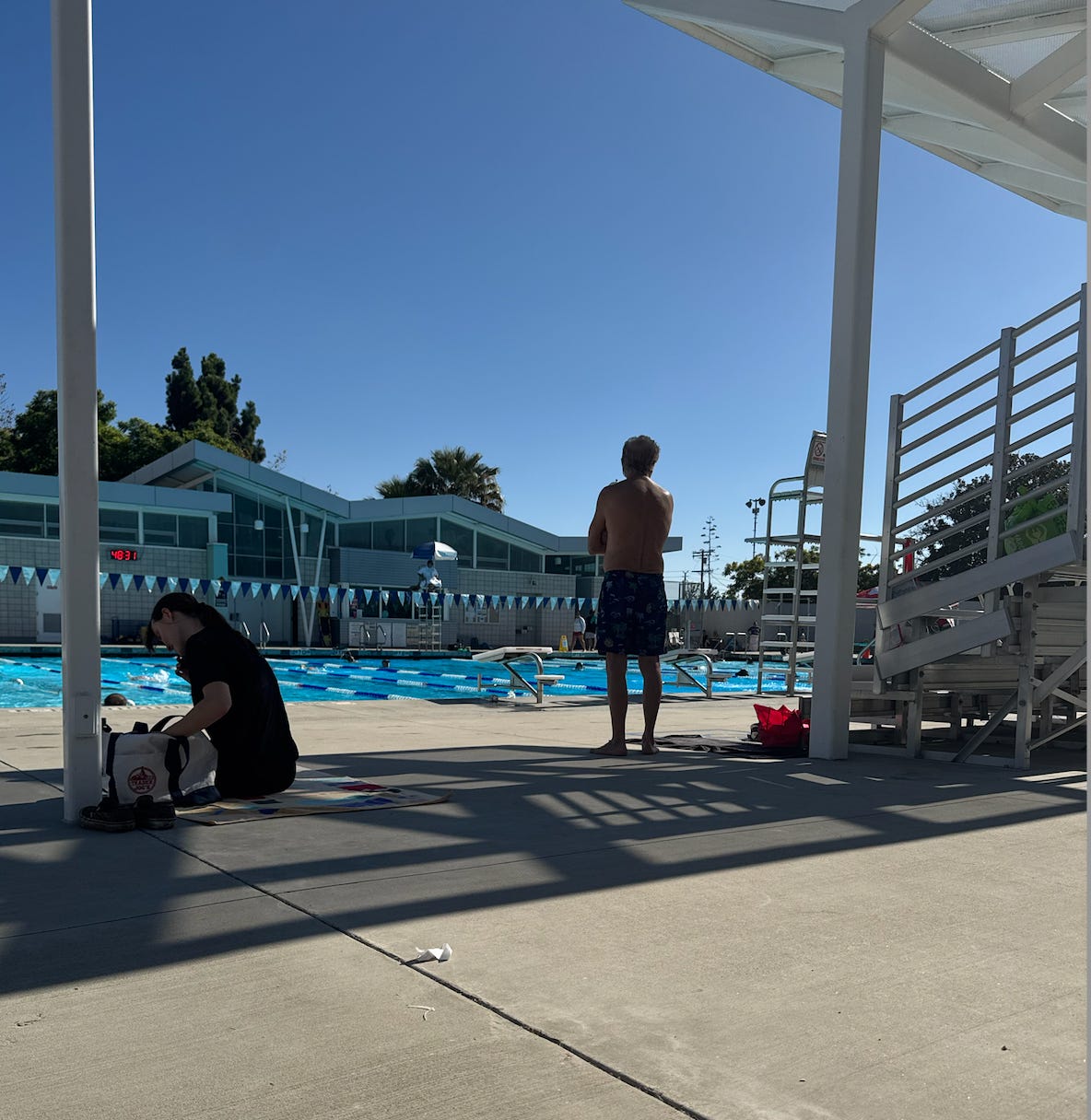
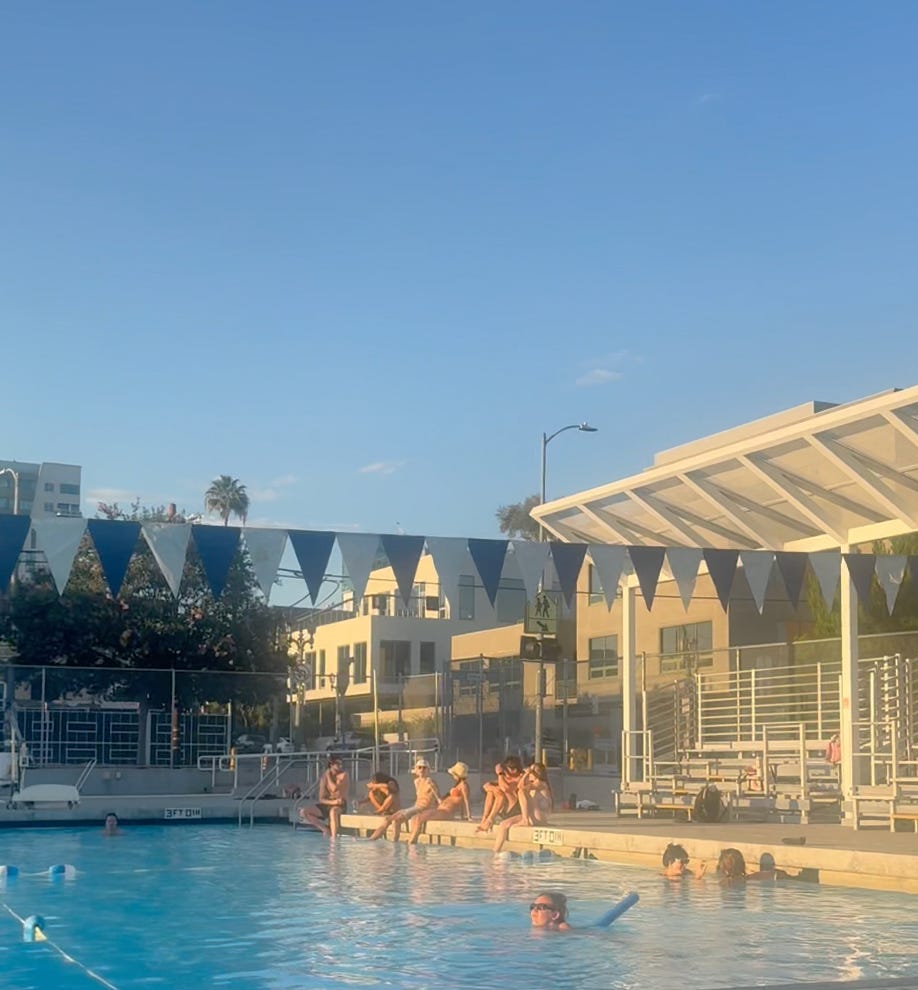
A woman swims for her 912th day in a row. Another woman tans on the pool ledge. A lifeguard clocks out. Before leaving, he lines up at the diving board behind mostly boys, aged 7 to at least 47. When it’s his turn, he takes a calculated step. Then another. Another. He jumps down hard, just once, and that’s enough to launch himself flying into an impressive double flip that ends in a neat dive. It’s perfect. It feels Olympic-worthy. Between Santa Monica Boulevard and Cole Avenue, hidden in Los Angeles’ concrete grid, sits the Hollywood Pool, this active patch of public park.
When we walk in, our friend Adam greets us from the shallow end, where he is doing his physical therapy exercises. He is a 59-year-old Angeleno born and raised in Watts. He lives in the neighborhood now and takes himself to the pool, via his electric wheelchair, seven days a week. Adam tells us, as he does almost every time we see him, that the pool is his medicine. The pool is medicine. The pool costs four dollars a visit and feels like the happiest place in Los Angeles.
But, as of September 25th, it closed for six weeks. This is a report from the last day at the Hollywood pool, and the few weeks thereafter.
The city of Los Angeles operates 57 swimming pools – 28 seasonal, 26 year-round, and 3 camp pools. The seasonal pools are open from June until Labor Day, and the year-round pools operate, in theory, year-round. But, for the past two years, the city has closed several of them, Hollywood included, between September and November. This year, as of October 22nd, 9 currently are closed, according to the city website. The news is sent down to each pool from the office of the Superintendent of Aquatics and Emergency Management. This office is currently held by Gary Singer, a local government official who’s job it is to “supervise”, “plan”, and “coordinate.” The reason for the closures? “Maintenance.” “Routine.”
The regulars are indignant. During the two months between the news and the shutdown, it is all anyone can talk about. People wonder about where else to go (most land on Laces or Van Nuys, both roughly a 25-minute drive away), wonder how their older neighbors will fare, wonder what to do with their kids, wonder how they will manage during the Los Angeles heat, wonder why no one is “thinking about them.”
And, mostly, they are trying to get to the bottom of the closures. They aren’t buying the “maintenance” explanation and they don’t understand why the closer pools, Eleanor Green Roberts and Echo Park, are shut down at the same time the Hollywood one is.
A consensus has emerged amongst a group of frequent swimmers: it’s budget cuts. That’s the popular narrative at least. Adam tells us it’s the budget. Christina, the woman swimming for her 912th day straight, tells us it’s the budget. And a man named David tells us that someone told him that someone else told them that it came down to funding the police or the pool. We ask him who told him that. He won’t tell us. He also won’t tell us his last name, saying, “You can’t be too careful.” Others blame Trump. The staff speaks less bluntly, but they do wonder about the scheduling decisions and why the closures overlap.
On the last day at the pool, and really almost any day, you could expect to see a seven-year-old boy running around the perimeter, squealing with joy as he finds patrons’ unsupervised water bottles, dumps their contents into the pool, and then jumps in himself. His mom chases him. The lifeguard knows him; he and his mom live close and visit often. Valentino’s mom, Gia, is proud of how fearless Valentino is in the water, and is upset about the closing. She says they need the pool, it’s part of his therapy.
Christina is particularly incensed and is seeking answers. She tells us, “They don’t care about the community, the special needs kids, the VA vets, the disenfranchised, or the lifeguards. Where are they going to go?” she asks. She blames the “paper pushers” who don’t “come down to the pools at all” for the decisions. In response, she has emailed not only Gary, but Karen Bass, Councilmember Soto-Martinez, Councilmember Heather Hutt, she attended the Silver Lake Neighborhood council meeting, and she got all her friends at all the pools to write in as well.
Gary responds to her email, telling her that they “made every effort to regionalize the dates to allow residents to utilize other nearby facilities” and “coordinated closely with our maintenance and construction division to create a closure schedule that balances both of our departmental needs” and that they will “look for every opportunity to open pools earlier.” This does nothing to convince Christina. She says the rest don’t reply, or send her similarly vague notes.
In the absence of a satisfactory explanation, the pool-goers landed on their own explanation, budget cuts, which seems only logical. Everyone knows the parks are underfunded in Los Angeles (though a ballot measure this November hopes to change this).
The city’s aquatics budget comes from the city’s Department of Recreation and Parks (RAP) budget, which gets its funding mostly from a property tax allocation required by the City Charter and from program revenue like pool passes. LA spends $92 per resident on parks. That is lower than every other city the City’s Park Needs Assessment benchmarked, and well below the $283 average of its peers. Between 2009 and 2023, RAP’s operating budget grew by only half as much as the entire city’s. The department has also lost 28% of its full-time staff and 9% of its part-time staff since 2008. A 2026 ranking of public parks by Trust for Public Land puts Los Angeles at 93rd out of 100 other measured cities.
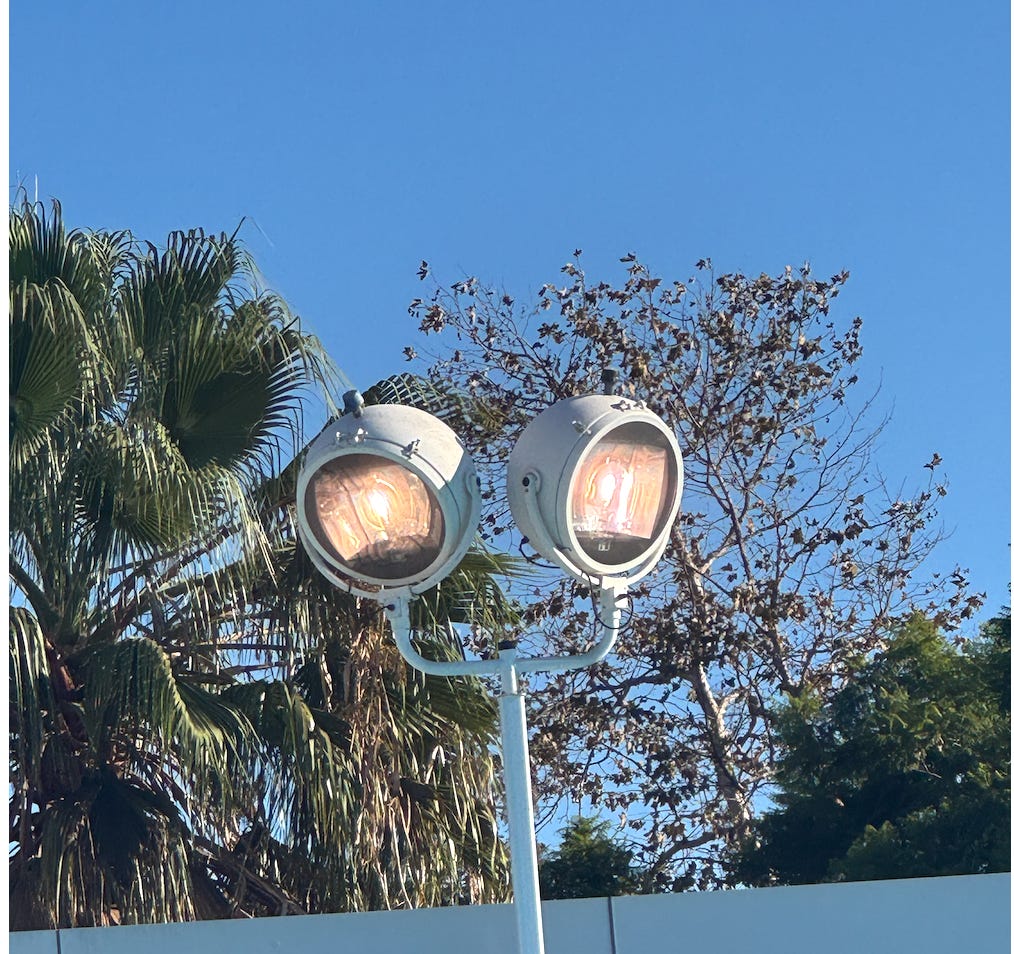
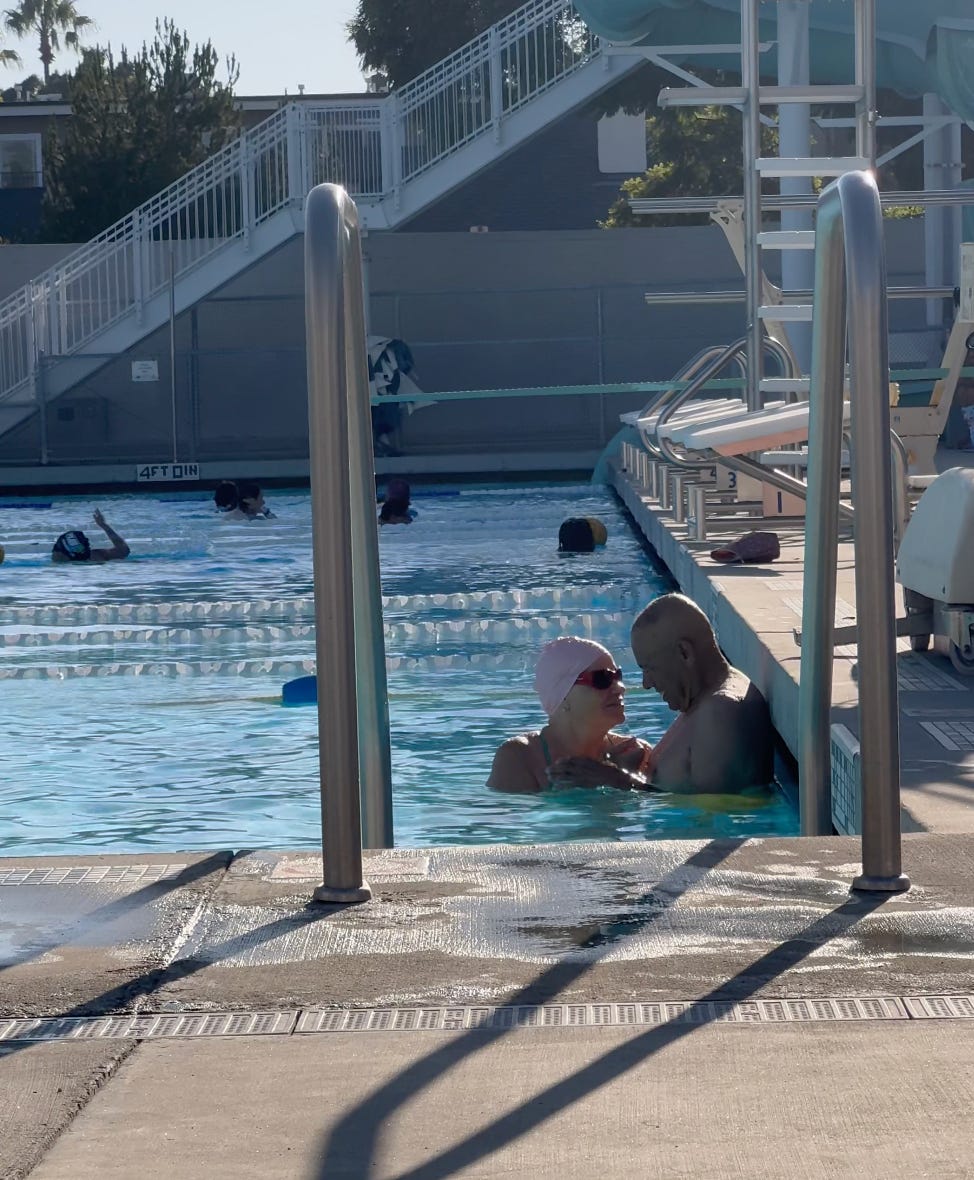
On the last day at the pool, we chat with one of the lifeguards who tells us he is going to stay with his sister in San Francisco for a bit. He tries to pick up other shifts at the pools still open, but they are hard to snag – it’s a first-come, first-serve system. At the other end, a few older ladies make their home in the wading area, squatting slightly so the water covers their shoulders, arms extended, floating next to them. There’s a chill to the air on this evening, so as the sun sets, they chase the rays to find a patch of warmth on the bleachers. Earlier in the summer, the lifeguards had dragged out a single large speaker from who knows where and would play soft jazz. There’s no speaker on the last day, just the hum of the overhead lights.
Two weeks after the pool shuts down, in early October, a record-breaking heat wave hits Los Angeles. The chill of September 24th was a fluke. Everything is hot. The sidewalks are hot, the cars are hot, we read a Reddit about someone’s glass breaking when they put cold water in it. The neighborhood around the Hollywood pool is hot, there are several blocks to the east of it with low canopy cover, marked “HIGH” and “HIGHEST” priority for more trees by The Tree Equity Scorer. We texted our friend Adam, who lives that direction, and asked how he was getting on. He said it was hard to keep cool but that he was drinking a lot of lemonade and iced tea. He needs to replace his AC unit. He’s tried to get to Van Nuys pool, but having to find a ride from either another pool regular or his daughter makes things difficult.
Public records show the aquatics department’s budget did, in fact, increase nominally over the past year. But after two months of emailing back and forth with Gary and the larger department, no one is able to answer our questions about the decision with any more specificity than they gave Christina. We asked for further information about what drove the closures, how and when the decision was made, and for specifics on what maintenance is taking place. To date, we haven’t received any of these answers. Christina tells us that she went by the pool and saw it had been drained, but doesn’t think they are doing any real maintenance work at all. Insiders tell us that years without budget resources have left the department “understaffed” and “hollowed out.” The silence could be read as incapacity or conspiracy, but, to those at the pool, it just seems like no one cares.
Christina has a proposition to make sure this doesn’t happen again: anyone in charge of running the pools or funding the pools must spend at least a month at the pools, picking up shifts as a lifeguard, understanding the medicinal qualities of a dunk on a hot day.
Then, in theory, the priorities of those with the drab roles and responsibilities of “paper pushers” might shift. And the people who decide on budgets and decide on what is closed when, and for who, and for how long, from a national level to a city level to a department level, might think about whether they want the pool to be open when it reaches 101-degrees. And then the gap of urgency between the pool-goers and the pool-regulators might close. And then some more of the pools might be open in October. After all, it’s hard to say no to a good time, but first you have to know just how sweet the good time can be.
i love the hollywood pool, it feels very strange that they randomly drain it and it just sits there empty, as strange as the construction at the park which sectioned off a perfectly good field not involved in the project that kids used to have a BALL at.