

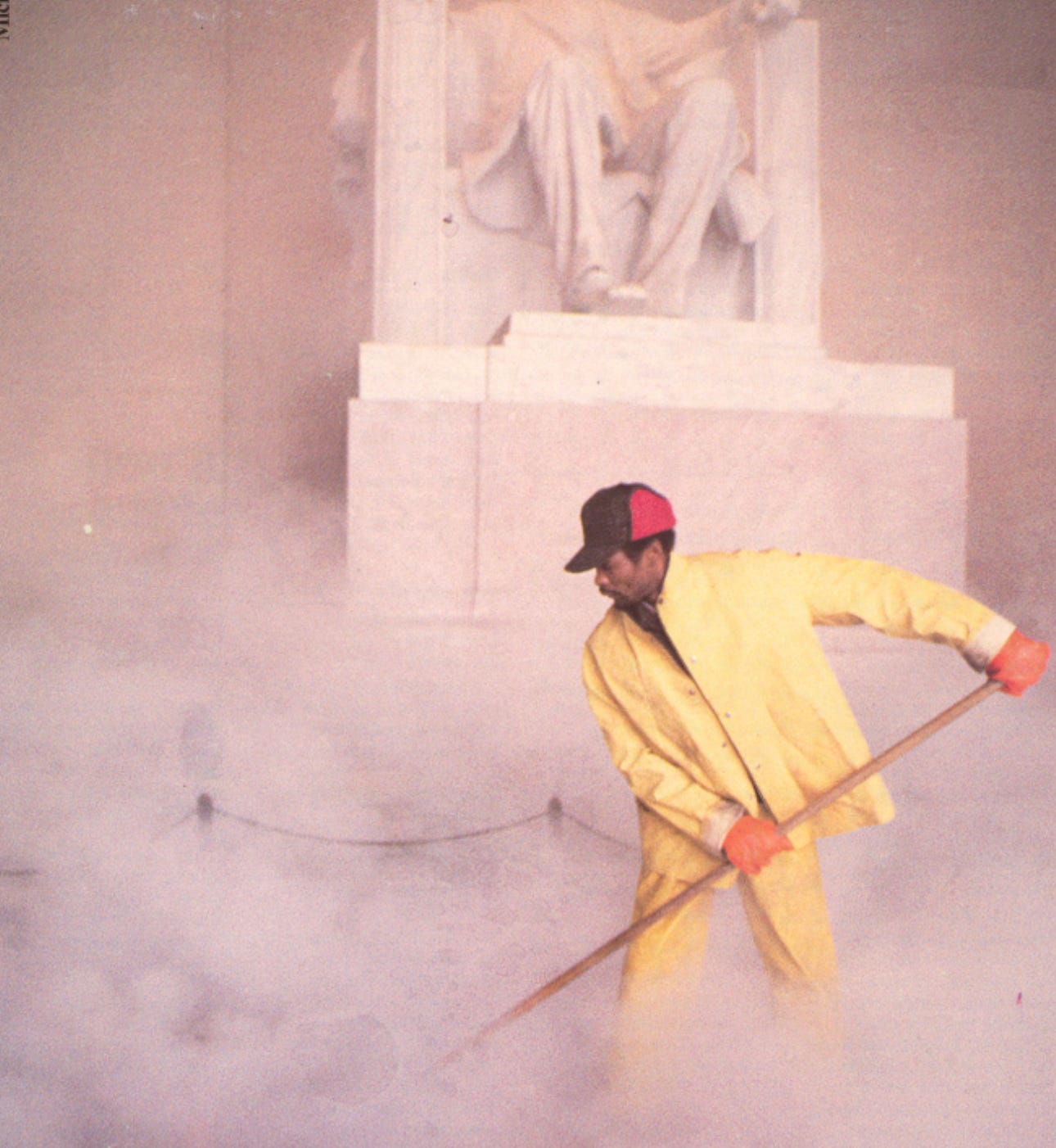
Bud Smith is a prolific writer, the author of the novels Teenager and Mighty, the short‑story collection Double Bird, and his memoir Work, among others. We reached out a few weeks ago because to talk to him about the reissue of Work, which is described on the publisher’s website as the story of “growing up in a campground in New Jersey, skipping college, and moving to NYC on a drunken whim.” He described it to us in the interview as a “self help book.” It was all of the above and we had a lovely time chatting with him about refusing to be precious, chasing the bag, choices, the tradition of storytelling, and… work.
This interview was conducted and condensed by Noelle Forougi for franknews. Subscribe to stay up to date and to keep franknews independent.
Tell us about your book!
Well, it’s called Work. It’s a memoir. It’s mainly centered around my time working heavy construction in the union in New Jersey, building, maintaining, and demolishing power plants, and oil refineries, but I’m a writer with a bunch of novels, short story collections, some poetry. Work is coming back out after being out of print for about five years. The small publisher went under, so I hunted around and tried to find a nice new home for it.
Can you describe what Work is about?
It’s a little bit about working construction, but really, it’s mainly about storytelling, creativity and how to blend that kind of stuff in with with a regular old workday. I like to read books like that…memoirs of people who aren’t exactly extraordinary people. I’m drawn to the story of everyday people working… what jobs they choose, or what jobs choose them, over a lifetime, and how they find a life in labor, creativity, family, balance, and everything.
Has it been weird revisiting it? How long has it been since you first published it?
I was shocked to find there wasn’t much that needed revising. I mean, I didn’t want to revise it at all. I wrote most of it in 2016. I was writing on my phone during breaks on the construction site. I was pretty much writing just essays, vignettes. I was writing one a week, first just drafts on my phone, and it started to become a book. Eventually I was like, “Oh, I’m actually writing a memoir,” which actually felt like writing a self-help book or something, which… I joke around a little when I say my novels are romance novels and my memoir is a self-help book, but part of me, as demented as the work itself can be, believes it. <Laughs>
That seems like your attitude. The end beat of your book struck a very hopeful tone of: “just do it and see how it goes.”
Yeah, exactly. I talk to a lot of people who feel so guilty about their output or something, they’re discouraged. There’s many things to discourage anyone who’s artmaking. Number one is probably money. Number two, everyone feels like AI has put the final bullet in things. I can see how it can get a person down, but for me, artmaking is just something I’ve done since I was a little kid, and I will continue to do till I’m in the grave. I don’t care about the money and I don’t care if AI makes my books obsolete. That’s inconsequential. The making is the great reward, the privilege.
I liked this quote: “I wanted to make my life a little less dull, a little less grim. Writing isn’t a precious thing. I’m not in eternal search of keeping what I do holier, built out of shining gems.”
There’s often so much pent up in the making of art that feels exclusive to people, but really it’s just about, like, life.
It is. I make a lot of art I don’t show, but I’m making something almost every day. And I feel like if you do a lot of work, you make a lot of stuff, after a while it kind of becomes hard to feel precious about anything because you’re just making. You worry about “am I going as deep as I could,” but that’s what revisions, and yet another draft, is for. I don’t ever feel bad when I’m making something. I feel bad maybe right before it’s going to come out, but that’s something different. I also don’t feel bad when I make jack shit. Everything in balance.
At the beginning of this conversation, you said you’re interested in the question of what jobs people choose and what jobs choose people over the course of a lifetime. Can you say more about that?
Well, sometimes we wind up in these situations where economically we don’t have a choice. Sometimes the jobs we want, we can’t have, and that sucks.
I joined a labor union for many reasons, partly because I felt like when I worked residential construction, my hours and my pay were at the whim of someone who not only owned the company but who was also often doing the manual labor there beside me. Those bosses were often stressed out and as a result, irrational. I felt that if I could just get in this labor union, I could work as hard as I have to but not have to kill myself because there were rules in place to protect the employees.
And everyone’s on the same level. Everyone in the union was equal, and no one really wants to be the boss, so we kind of take turns. It’s like, “Oh shit, okay, now you have to be the boss this week,” and we pick up each other’s slack.
Being on a crew in a trade union is pretty damn utopian. There’s hardly any animosity between the workers. When I was working non-union, there was more strife. You took break when the boss said you did, you stopped for the day when they said so. The goal posts were always shifting.
I wanted to have a good chunk of my life dedicated to creativity, labor, family, and I wanted to find a way to balance all these things. This was one of my goals in my early 20s – to pursue a life of not striving for crazy things career-wise that I didn’t think would make me happy anyway.
I do fine. Working construction in the union, it pays fine. No one’s getting rich doing what I do, but no one’s struggling. It’s like the last perfect middle-class, or probably right at the cusp of upper-middle-class, jobs. And I’m on my 20th year now of doing this stuff, around 20 years of officially publishing books, and I’m just grateful I went this route.
Do you find that one job makes the other better?
Some of it does. I’ve written a fair bit about working on these crews, working with a lot of the different crafts people, and you get stories from that. Also, you learn a different kind of storytelling – an oral style.
A lot of times you meet a bunch of strangers, and you really have to connect with them. If you’re going to work with someone doing something dangerous, you have to be able to trust each other, and it’s important to be able to talk. Some of the people I work with, maybe they came from the armed forces, a few of them were in prison, they learned how to talk in places like that. And so you learn from them.
I think I have a very dry sense of humor too, and sometimes it takes people a while to figure out what my deal is. Like, “You can’t believe anything that guy says,” which is true, you kind of can’t believe anything I say.
When I first started working on these job sites, the older generation of men and women everywhere, would have jokes memorized. It’s like when I was a kid, there would always be older people reciting poems. That kind of thing has kind of faded, and it’s sad to see that stuff go, but times change. And when I get bummed out about something like staring at my phone too much, I print out a poem and try to memorize it, try to go back to something a little simpler like that. Though I do love that we can have this conversation video conferencing right now. There’s good and bad to it.
Have you read Studs Terkel’s Working?
People always give me that book. I’ve skimmed through it. I haven’t read much of it, no. But I absolutely need to change that.
I was just rereading it and he is talking to a steelworker about automation, and the guy says: “Depends how it’s applied. It frightens me if it puts me out on the street. It doesn’t frighten me if it shortens my work week. Machines can either liberate man or enslave ‘im, because they’re pretty neutral. It’s man who has the bias to put the thing one place or another.” Which basically feels like a very timeless perspective on automation…
There’s a John McPhee book I like a lot called The Pine Barrens, because I’m from right on the edge of the Pine Barrens. I grew up on the Jersey Shore, in a town right south of the one where they made the TV show Jersey Shore. On the western side of the town, that’s where the Pine Barrens start.
A chunk of the John McPhee book is set in the early ‘60s, driving around through the Pine Barrens and through towns where people had been living before everyone gravitated toward the cities when the factories came along.
Things change, industries change. When I first started, about half of my work was in coal-fired power plants. The coal would rip apart the tubes that go from the boiler up to the turbine. So they’d shut the plant down, and we’d go inside these things and rip apart the plant and replace all these tubes, hundreds of feet, weld them in. It was a lot of work.
But living in the same town I live in now, Jersey City, in view of my apartment building is where one of those old coal-fired power plants used to be. I’m happy it’s not there anymore, happy it’s not pumping out pollution, even though I worked there for a year putting on a pollution control scrubber unit. But as a resident here, I’m happy there’s not a coal-fired power plant down the hill from me.
And our union has shrunk down, just in this state, from about 700 members when I started 20 years ago to a little over, I think there’s like 275 now.
Which union?
The Boilermakers Union, which is what I’m in.
And does any of that have to do with offshoring at all, or is it all just a shift in technology?
There’s been a shift in technology. The coal-fired power plant has been replaced with cleaner-burning natural gas, which is easier on the plant itself, requiring less maintenance. So now you might only open the thing up once every ten years, so it’s less labor for the people doing it.
On one hand, there’s a temptation to feel nostalgic, “the golden days of our union.” But I’m also genuinely happy to see environmental progress, and to see where technology can take us. There are trade-offs with everything, though. The pursuit of power and light is hard on the planet. Everybody knows that. Everybody knows it’s bad for the planet when they fill up their car with gas. Take the petroleum industry — the refineries I used to work at in New Jersey are closed, some because the company switched from refining to exploration. That company is drilling off Alaska now, discovering oil instead of refining it, so those jobs disappeared. Is it sad that people have to go find something else to do? Yes and no.
There was part of your book where you write about someone saying, “It’s cool you work a ‘real job’, with your hands.” And then you write “The guys I work construction with all talk about working ‘real jobs’ too, except they’re talking about ‘not working here.’” Do you think there is an upsurge of people romanticizing more manual labor?
It’s hard for me, because I can romanticize almost anything. But I’ve never really heard anyone get too romantic about working in a factory. I come from a family of factory workers on my mom’s side. She worked in a factory making aerosol spray can products for Arm & Hammer, and that was one of my options coming out of school: go work in the factory, or go work at the junkyard. Those were basically my choices, and I remember thinking, is there a secret third thing?
Of course, I could have gone to college, but I wasn’t too impressed with the classes at the community college, and I figured I had a whole lifetime of self-learning ahead of me anyway. That’s served me well, but I do applaud anybody who can pick something they want to study, figure out what they want to do, get the degree, and end up on the path they want to be on. It’s hard sometimes, especially at 19 or 20, when everyone’s asking, “Do you want to go into debt for college? What do you want to do with your life?”
Completely. Last question – you touched on this a little at the beginning, but I think most people start creatively inclined, and that gets dampened over the course of life. What do you think you’ve done, or what’s different in you, that you seem to have carried it through all the stuff of life?
I think you have to find a higher purpose, something that can get you through the low times. But when I was a kid, I grew up in a house full of arts and crafts. My mom, not to keep beating this horse, worked in the factory, night shift, but when she was home, she was at her table in the kitchen. The kitchen table was always full. Of course when we were eating, it’d get cleared, but otherwise the crafts were everywhere. She’d be sewing, constantly making stuff. My father was the same way, always working on machinery, ripping a car apart in the driveway to fix it up and resell it — after his regular job, which was fixing broken down garbage trucks and police cars for the township. Projects. They always had projects.
I was constantly reading, constantly watching movies from the video store down the street, and just making stuff. My nieces are like this now, always making little books. At a certain point, for most people, that stops. You start to feel silly about it, but I kind of never really stopped. I always had a book I was working on, or trying to. I played music for a long time. I was always making an album that never quite got recorded or finished. I was always going to make films with my friends; we’d write the scripts, shoot scenes, and never quite bring it home.
I think that’s partly why I had that non-precious relationship with it. I’d seen how much joy it brought me, from age six or younger, all the way into my early 20s, and I understood that you can just make art. It doesn’t need an end goal or destination. It doesn’t matter if you get there, doesn’t matter if you finish your movie. It was so fun to shoot it with your friends, so what if you don’t know how to edit it, or you overdub the music badly, or you don’t have all the skills and never quite get there. Just making things brought so much joy.
By the time I realized I could actually finish things, it became a different kind of gear, I was really doing it. And then I had to ask myself: do I want to dedicate even more of my energy and time to learning this? It turned out, yeah, I did. But I had to ramp myself up to it. And then theres a whole new set of things to master or learn. I could see how it drives people crazy, but again, I just thought the whole thing was a privilege.
I think the pursuit of fame has become so prevalent, and feels so tangible and desirable to so many people, and fame gets lumped in with the pursuit of art. And then never “making it” becomes a sad failure, but really, it’s a joy to be able to do any of these things.
There is no “making it”, there is no “bag to get”, and there is no “eternal reward” either. There’s today. Feel good today. If you can do it, if you can sit down and write a draft of a novel over the course of a year or two or three — you did it. That’s it. There’s not much more to it than that. Feel satisfied. Feel proud. I don’t know, here’s another suggestion, get real high and stare at your hand and realize you’re already a miracle full of nerves and bones and blood and dreams. What’s the alternative? Hate that you were born? Nah.
loved this so much