But Not LA
Sam Bloch on shade, demanding a higher quality public realm, and “Fortress LA.”


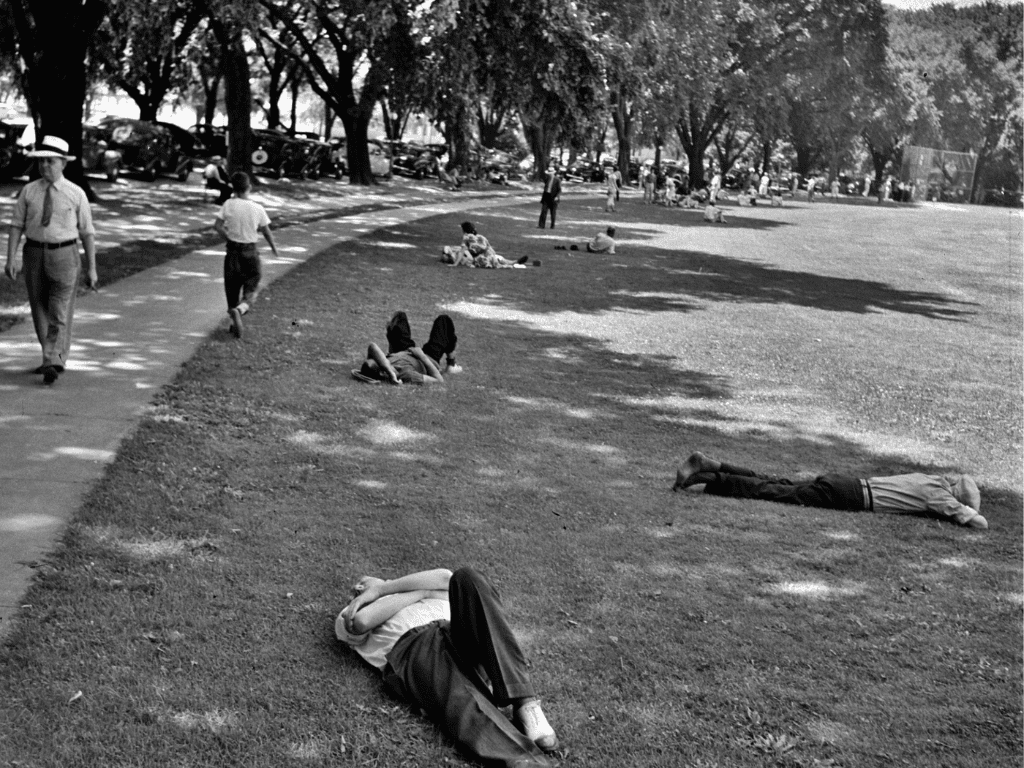
We first started talking about shade and how it relates to public space a few years back when we spoke with Ersela Kripa, an architect based in El Paso. Back in 2022, she told us: “We assume we have specific rights as they are guaranteed by law in public space, but those rights become really unevenly distributed depending on who the person is.” Our interview today with Sam Bloch picks up on that thread — asking what we should demand from our public spaces and what happens when we can opt out of them. We spoke with him about his book “Shade”, the weaponization of heat, “Fortress LA”, and trees as infrastructure.
This interview was conducted by Noelle Forougi for franknews, and condensed for clarity. Help keep frank independent, ad-free, and for everyone, by subscribing below or donating here.
Do you mind starting by introducing yourself, and I’m curious to hear a little bit more about how you came to the book?
My name is Sam Bloch. I’m an environmental journalist and the author of Shade: The Promise of a Forgotten Natural Resource. This book grew out of an article that I wrote for a publication called Places Journal — at this point published a long time ago now, in 2019 — and that article was all about shade inequality in LA.
I used to live in Mount Washington, and like most people, I didn’t really think about shade until I was in the sun. Mount Washington has some of the city’s highest tree canopy cover. It’s over 50% shaded by oak and sycamores and eucalyptus trees, but when I left the neighborhood and went down to the flats in Cypress Park, where there were no trees, I could feel the change. It was just so much brighter, and more exposed, and hotter.
I began to dial in on shade as a social issue and an index of inequality when I looked more closely at a bus stop on Figueroa Street in Cypress Park. I noticed the bus riders, waiting for their ride, were all standing in the shadows of street signs and telephone poles — the only shade they could contrive. A lot of people think of LA as a place for drivers, but there’s at least 700,000 people who ride the bus every day, and at least within city limits, around three-quarters of them have no dedicated shelter from the sun. That’s a lot of people who have to wait in the heat.
I wanted to know more about these desultory conditions at the bus stop — why this place that was so critical to so many people was such an afterthought, compared to the comfort afforded to drivers who motor around in their little air-conditioned bubbles. My journey into the darkness, you might say, began at the bus stop.
You have this anecdote that starts off your book about a man named Tony Cornejo, a barber who sort of took matters into his own hands and built a makeshift shelter for the people waiting for the bus.
That bus stop I just described was actually outside his shop. Tony didn’t think it was safe for riders to wait in that heat. They were “burning themselves out there,” he told me. So one day, he strung a gray plastic tarp over the sidewalk, and dragged a few crates underneath to make a bench. And his shelter seemed to work and people seemed to like it — that is, until the authorities discovered what he’d done, and made him take it down, because they considered it unsafe.
The street hadn’t been designed or engineered with bus riders in mind, and it certainly hadn’t been designed with shade or heat in mind. The sidewalks were too narrow to fit a proper shelter. There were too many alleys that required large clearances for driver safety. Power poles and street signs gobbled up the room that could have been used for trees. Tony was doing what he could to improve the conditions. But his efforts fell afoul of the regulations.
It seems like part of the reason individuals have to take things into their own hands is how we think about heat. People in charge don’t think of heat as a natural disaster because it’s not as immediately horrific as a fire or a hurricane.
Right. I live in New York now, and we just went through an extremely snowy winter here that effectively ground the city to a halt. School was canceled, people couldn’t use the sidewalks — the infrastructure was paralyzed. When there’s three feet of snow on the ground, pretty much everyone is affected. But that doesn’t really happen the same way with heat. On a really hot day, or during a heatwave, the experience of the weather changes based on socioeconomic status. In LA, it’s easy for drivers — who tend to be wealthier than transit riders — to escape it.
You write a lot about places over history that were designed for shade. Where did that philosophy not carry over, at least to the US?
In my book, I talk about Mesopotamian cities that were built thousands of years ago. Back then, there were no cars, no buses, barely even domesticated pack animals, so people just had to walk everywhere. In what is today modern-day Iraq, the conditions could be incredibly punishing when you were outside, so it made sense for the earliest city builders to design cities that were a little cooler and shadier. Ur was laid out on a diagonal grid, which meant all the buildings shaded each other and the roads as well, pretty much throughout the day. The roads were very narrow too — no wider than the height of the buildings — which further limited exposure to the sun.
That kind of urban design made a lot of sense in that climate — so much so that one archeologist I talked to suggested that shade is the reason why cities actually took off in that part of the world. The microclimate of a dense settlement was preferable to the blazing heat in the dispersed villages on the plain. And it made a lot of sense for thousands of years, all the way up until the edge of modernity, where we came up with other, better technologies for cooling — specifically, air conditioning. That’s when shade became an afterthought and a bit of a luxury.
There were a few moments in your book where I was reminded of some of the talking points of the abundance agenda.
That’s funny. I did an interview with Andrew Yang and afterwards he said that shade should be one of the planks of the abundance agenda.
Ha! I’m not trying to wade into that debate too deeply. But there were a few anecdotes – Tony Cornejo couldn’t keep his makeshift shelter up on the street because of a disability regulation, and you point to the California Solar Shade Control Act that limits the amount of shade that can fall on a house.
How do you think about the current regulation in the grand scheme of things?
I’m not against regulations. I’m actually arguing for more government intervention and more investment in a shadier, cooler public realm. In the example of Tony Cornejo, his street had been built to make life easier for drivers, not for bus riders or pedestrians. That design, combined with modern rules and regulations that control sidewalk access, made it a lot harder for him to add more shade, in a place where it was really needed. Those same rules and regulations could be used to encourage shade — what if, for example, the government had permitted his structure and offered him a tax incentive, or something like that, for his neighborhood improvement?
That’s the easy part. The hard part is the long-term project of reimagining the street and what it should be used for. I just came back from Austin, Texas, where climate scientists are predicting three to four months of dangerous heat every summer in the near future. The city’s transportation and urban planners are really worried about that, because Austin has all these expensive transit projects coming online, and they don’t want people to feel like they’re going to die waiting ten or twenty minutes for the train. Because if they do, they simply won’t do it — they’ll just keep driving instead.
I talked to a contingent of them in City Hall and they all bemoaned that there’s not a lot of room for them to add shade in the right-of-way, because of all the utilities there. It’s a million-dollar project, every time, to rebuild a street to move the wires and conduits around to accommodate new tree roots or footings for shade structures. That’s the difficulty of permanently retrofitting a 20th century city for the problems and the climate of the 21st. If city leaders are serious about creating livable public spaces and preserving the ones that already exist, it’s going to take a serious reshuffling of their budgets and planning priorities.
As a layperson, I get hung up on that part – “retrofitting a 20th century city for 21st century problems.” I hate to be a cynic, but at what point is our infrastructure too deeply entrenched? For example, a lot of these issues come down to how wide the roads are. A lot of the road sizes don’t lend themselves to shade, but it costs millions to rebuild them. So how do we reverse that?
In American cities, there’s just not a lot of political capital to find the literal capital to do that. So if we can do these DIY tactical retrofits and encourage them in places where it’s going to be too expensive to rebuild an entire neighborhood, that’s at least a temporary solution, until we do have the capital.
And then longer term would be political pressure?
Longer term, it has to be a coalition of people who are really suffering from heat — parents whose children have nowhere safe to play outside, street vendors whose economic livelihoods are impacted by the climate, and people who are physically endangered by high temperatures, like the elderly, people with physical disabilities, and outdoor laborers. Environmentalists need to partner with pedestrians, bike riders and transit riders to make the case that sustainable forms of transit and mobility are more accessible and more attractive to the general public with shade. That’s the kind of broad constituency that has to emerge to demand action and exert political pressure.
It would be wrong to say there’s no money for shade. Our cities already spend so much of their budgets on public safety and police, and of course on a federal level, we’re now spending billions of dollars every week to bomb another country. The money is there. It’s just a matter of finding the political will to use it.
Everything seems to come down to that.
It really does! I think a lot of people are interested in this book, and shade more generally, as this cool idea — pun intended — or a gizmo, or a quick fix, for climate change. And that’s fine. But it’s wrong to suggest that some neighborhoods should accept DIY bus shelters as the best they can do when others are afforded cool, luscious urban forests. Creating shade durably and fairly comes down to organizing and creating political movements.
I like how you phrase it in the book – thinking about trees as infrastructure. Is there anything interesting you’re tracking that moves us towards that, I am particularly curious about LA.
When I started working on this book, Mayor Eric Garcetti was promising to boost the tree cover by half in poor neighborhoods and install shady bus shelters at 750 stops. What did LA get instead? La Sombrita and Mayor Karen Bass practically zeroing out the entire city budget for tree planting.
So long as LA continues to treat trees as amenities, and their maintenance as something done by volunteers and sustained by neighborhood goodwill, then it’s never going to be funded, allocated and distributed equally, the way we expect infrastructure to be. For example: Would we ever expect our neighborhood to get together on a Saturday morning to clean the sewers? Or designate a group of volunteers to restore power to the grid after a blackout? Or fill a pothole in the road? Of course not. But that’s exactly how LA treats its supposed green infrastructure of trees. Portland, San Francisco, and New York City all adequately fund urban forestry and manage public trees as city assets that should be standard in every neighborhood. But not LA.
Yeah, I do feel like New York does do a good job — trees are pretty prevalent. What is the difference?
Number one, climate. Leafy trees want to grow in a temperate climate like New York’s where they get lots of rain. Not so in LA and other Western cities — which is why I’m bullish on other forms of shade that don’t rely on watering, like awnings and canopies and shelters.
Number two, New York is a wealthy city, which means there’s money from taxpayers, and private individuals and foundations for ambitious programs. It’s still the only American city that actually fulfilled its Million Tree pledge.
And three, it’s a city of walkers. I think, in general, more New Yorkers spend more time on their streets and sidewalks and parks than do Angelenos — and so they demand a higher quality public realm. Other than the people who rely on public transit, a lot of Angelenos don’t experience the public realm in the same way — they just drive everywhere.
There are ways out of the public realm that people can opt into.
You spoke about using heat as a method of policing. Can you explain a little bit for our readers?
We’ve been talking about how shade has been neglected by urban planners — how it’s deprioritized to make room for cars and utilities and so forth. But what shocked me is that in LA, there are people actively trying to remove shade, too. There’s this tendency among LAPD officers to believe that too much tree cover impedes their ability to do their jobs. Beat cops in South LA and in the Valley tell property owners to get rid of trees that block their views from cameras or cruisers, and work with other public authorities to get rid of trees whose shade is used by loiterers, day drinkers, and homeless people.
Never mind that this is happening in the hottest neighborhoods that already have the highest temperatures and the scantest tree cover. Shade removals take away opportunities to participate in public life. It seems to me that cops who hate shade are in their own way expressing a fear of the public and the unruliness of public life.
That actually also reminded me a lot about the 1990s shift of our immigration policy to prevention through deterrence – which basically meant we were going to force people who wanted to migrate through deadly, hot deserts instead of urban centers. A weaponization of heat.
You also thread in your book this history of the word “shady” and this long history of a fear of the public…
Yes! The umbratici of ancient Rome. This was the word the cultural elite used to describe the people who gathered in the shade of public porticoes. It literally translates to “shady people.” People in power have a long-standing bias against shady places where no-goodniks and prostitutes and beggars and deviants hang out. And that continues to today’s policing methods.
Maybe the most famous example of this in LA is downtown’s Pershing Square, which in its most iconic design was a traditional leafy park — that is, until too many hobos and homosexuals were hanging out there, and then business owners sponsored a redesign to basically clear out the park and expose those criminals to the light of the sun. This idea that you can’t have comfortable public space, because it’d attract the wrong kind of people — that feels so LA to me.
And didn’t you write that the Pershing Square trees ended up at Disneyland?
Yes, a little on the nose, right?
Totally. Like a scene from an Adam Curtis documentary.
And it’s dumb because the same rich people who were interested in punishing one group, end up hurting their own quality of life in the process. And then they lament that they, like, don’t have good, walkable city planning and move to New York.
Right. It’s like how everyone says the best urbanism in LA is actually at The Grove.
How are you dealing with the heat? I heard it’s getting hot in California.
Yeah, it’s 90 today. It’s hot — and I hate to tell you this but the AC is cranking.
<Laughs> I don’t begrudge people who use AC. We’re all going to need AC in the future. The problem is that our buildings can’t function without it. Unless we want the planet to keep getting hotter and hotter, we need stronger building codes that make homes stay cooler using less energy. And unless we just want to stay inside all day, we need more shade in our neighborhoods — which also means our homes won’t get so hot in the first place.
For sure. Well, thank you so much, I really enjoyed reading your book.
Any time!
 | A guest post by
|